

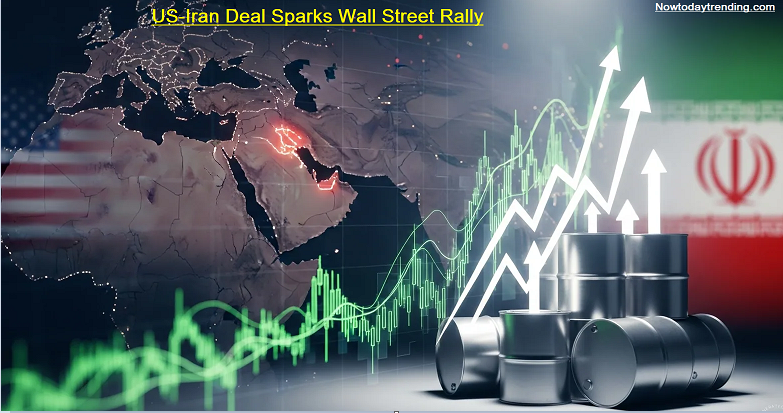
The global financial landscape witnessed an unprecedented shift on Monday morning as U.S. stock futures surged following a historic diplomatic breakthrough. Over the weekend, the United States and Iran officially announced an interim peace deal, successfully bringing an end to nearly four months of intense military conflict that had heavily disrupted international trade and roiled energy markets.
With risk appetite completely restored overnight, Wall Street is pacing toward a historic trading week. Investors looking to capitalize on American market momentum are closely tracking how this stabilization is shifting capital into high-growth sectors.
Wall Street Futures Explode as Tech Stocks Lead the Charge
As the opening bell approaches on Monday, June 15, 2026, the reaction across financial assets has captured the absolute focus of institutional traders. Financial metrics show high optimism across major American indices:
- Nasdaq 100 Futures: Leading the market-wide rally with a massive 2.1% spike, fueled by tech stocks rebounding on hopes of lowered global inflation.
- S&P 500 Futures: Advanced by 1.3%, signaling broad corporate confidence as international supply chain constraints dissolve.
- Dow Jones Futures: Climbed by 1%, extending the positive momentum generated late last week.
The relief rally isn’t isolated to New York trading floors. International benchmarks have reacted similarly; Japan’s Nikkei 225 index skyrocketed 5.5% to hit a historic intraday high, while South Korea’s Kospi surged over 5.2%.
Reopening the Strait of Hormuz: Why Energy Markets are Tumbling
The core element driving this massive Wall Street rally is the structured reopening of the Strait of Hormuz. The crucial maritime passageway handles roughly 20 percent of global crude oil transit, and its four-month closure due to naval blockades and military operations had kept global energy prices high.
Under the framework announced by President Donald Trump and international negotiators, the U.S. military will lift its naval blockade on Iranian ports. In return, Iran will guarantee unhindered commercial shipping passage through the strait.
As supply disruption fears instantly evaporated, global oil prices plummeted by roughly 5%, with Brent crude dipping down toward $83 a barrel and West Texas Intermediate (WTI) falling close to $80 a barrel. Lower energy costs provide immediate economic relief to inflation-weary Western economies, giving the Federal Reserve more breathing room regarding interest rate cuts.
60-Day Technical Ceasefire and the Path to Switzerland
According to official updates, the newly established agreement outlines a 60-day negotiation period where both Washington and Tehran will engage in intensive diplomatic talks regarding Iran’s nuclear capabilities and frozen state assets. Pakistan’s Prime Minister Shehbaz Sharif, whose administration played a pivotal role as a key mediator throughout the crisis, confirmed that an official interim signing ceremony is scheduled to take place this coming Friday in Switzerland.
While some market analysts warn that the underlying geopolitical tensions will take months to completely settle, the immediate termination of military operations across all active fronts provides a massive sigh of relief for global supply chains.
How to Position Your Portfolio on NowTodayTrending
For active retail traders tracking updates on platforms like NowTodayTrending, this historic deal opens up precise market opportunities:
- Bullish on Tech & Transport: With global tension subsiding, growth assets, aviation stocks, and consumer tech are expected to outpace defensive sectors.
- Shorting Traditional Energy Safes: The sudden influx of crude oil supply means traditional energy-heavy portfolios may face short-term corrections.
- Tracking the 60-Day Windows: Volatility is likely to re-emerge around technical announcements later in the summer, making early entry into broad market index funds a favored choice among American retail investors.













Leave a Reply