

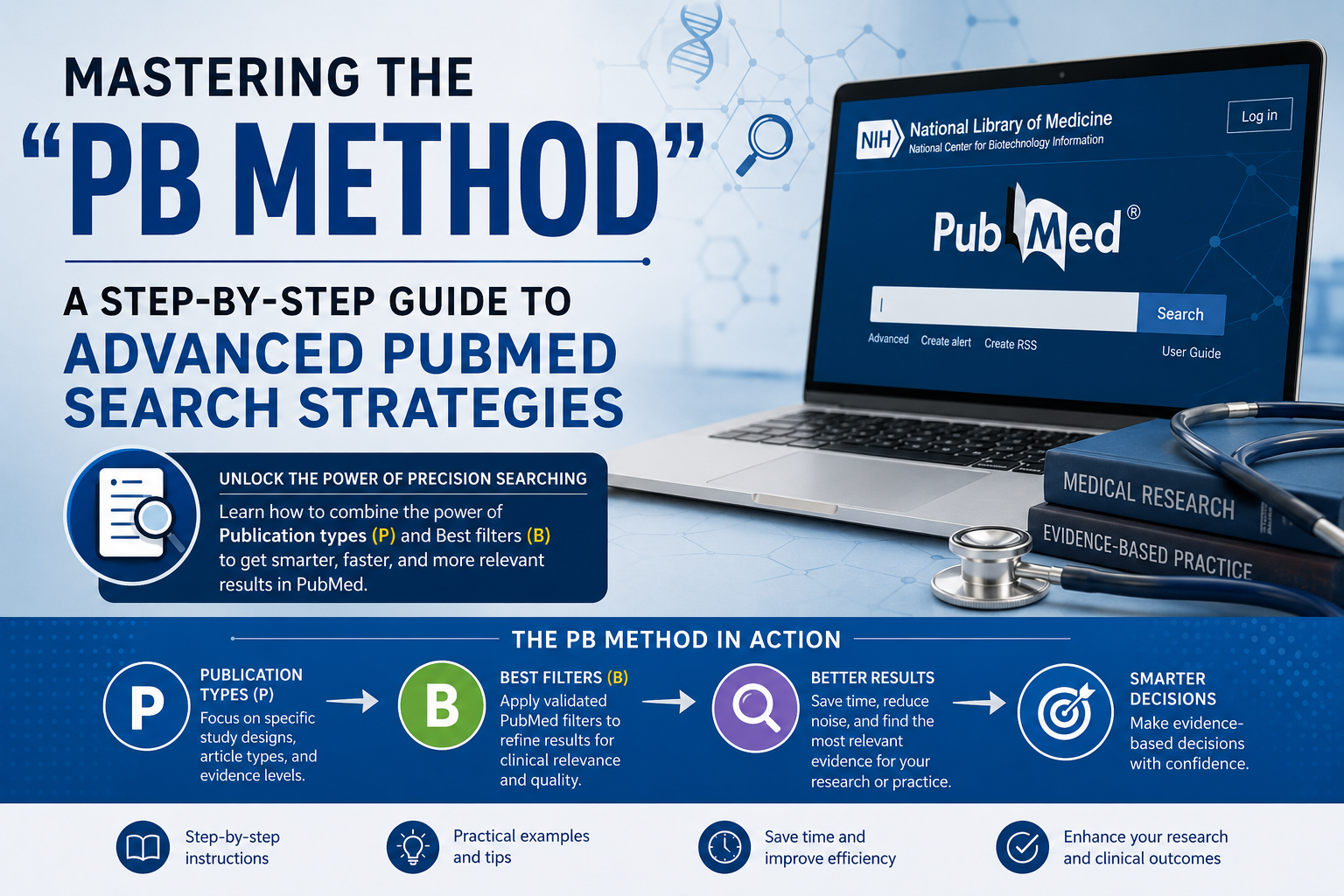
The digital landscape of medical research requires precise data retrieval methods. For healthcare professionals, academic researchers, and clinical students, navigating millions of biomedical citations demands more than a basic keyword search. Standard algorithms often yield irrelevant results or omit cutting-edge papers due to variations in terminology.
To overcome these barriers, experts rely on a structured syntax protocol known as the PubMed Method (PB Method). By transforming open-ended scientific questions into rigorous, machine-readable search strings, this architecture optimizes retrieval efficiency across global biomedical repositories.
Phase 1: Structural Foundations of the PB Method
The blueprint of any sophisticated literature search begins long before interacting with a digital interface. Relying on an unstructured stream of consciousness introduces systemic bias, missing critical papers while burying researchers under thousands of unrelated articles. The advanced method rectifies this through a multi-tiered structural framework.
[Clinical Research Question]
       │
       ▼
[PICO Framework Segmentation] ──► (Population, Intervention, Comparison, Outcome)
       │
       ▼
[Vocabulary Mapping] ──────────► (Standardized MeSH Terms + Title/Abstract Keywords)
       │
       ▼
[Boolean Syntax Matrix] ───────► (AND / OR / NOT Relational Operators)
Step 1: Executing the PICO Matrix
The initial step requires deconstructing an abstract clinical curiosity into a highly concrete PICO baseline:
-
- Population (P): Defining the demographic or disease state with exact specificity, such as geriatric patients diagnosed with localized stage-two pancreatic adenocarcinoma.
- Intervention (I): Identifying the precise therapeutic agent, diagnostic test, or lifestyle exposure being analyzed.
- Comparison (C): Isolating the alternative variable, standard of care, or placebo control group against which the intervention is measured.
- Outcome (O): Pinpointing the measurable clinical end points, such as overall five-year survival velocity or down-regulation of specific serum biomarkers.
Step 2: Harmonizing Controlled Vocabularies
A common failure point in research retrieval is variations in medical terminology. Authors globally utilize divergent nomenclature for identical pathologies—one paper may reference “bariatric surgery” while another documents “Roux-en-Y gastric bypass.”
The advanced method eliminates this fragmentation by using Medical Subject Headings (MeSH). Maintained by a centralized taxonomy system, MeSH acts as a universal indexer. When an article is added to the database, experts tag it with these standardized headers. This ensures that a single search term retrieves relevant material regardless of the specific vocabulary chosen by the authors.
Phase 2: Building Advanced Search Queries
Once the vocabulary map is complete, researchers build the actual search string. This phase combines controlled terms with raw text strings using strict relational operators.
Implementing Boolean Logic
Boolean operators serve as the logical connective tissue of the query string. These operators must always be written in uppercase to override standard text-matching behaviors:
-
- The OR Operator: Used to group synonyms, alternative spellings, and related concepts within a single PICO category. This expands the search boundaries.
- The AND Operator: Used to intersect the separate PICO categories, forcing the search system to only return articles where all distinct conceptual components overlap.
- The NOT Operator: Used to eliminate known confounding variables or irrelevant branches of medical literature, though it must be used cautiously to prevent accidental data exclusion.
           ┌────────────────────────┐
           │   Concept A: Patient   │
           │  (Pancreatic Cancer)   │
           └───────────┬────────────┘
                       │
                   [ AND ]
                       │
           ┌───────────▼────────────┐
           │ Concept B: Intervention│
           │    (Immunotherapy)     │
           └────────────────────────┘
Utilizing Precision Field Tags
To maximize accuracy, researchers use specific field tags trailing their search terms within brackets. This restricts the indexing engine from reading secondary or non-essential mentions of a word within the footnotes or references of a paper:
-
[Mesh]: Forces the interface to look exclusively within the assigned Medical Subject Headings index.[tiab]: Limits the search tracking mechanism strictly to words appearing inside the Title and Abstract text fields. This ensures the term is a central focus of the article.[tw]: Searches Text Words broadly across major metadata classifications, providing a balanced midway point between restricted precision and wide-scope discovery.
Phase 3: Proximity Architecture and Search Logic
Advanced execution of the methodology requires understanding the internal mechanics of the search interface, particularly how terms interact with automated indexing systems.
Proximity Commands
Real-world research often requires finding multiple words that must appear near each other to form contextual meaning, without being bound into a rigid, unbroken phrase. This is accomplished using proximity parameters. By applying a specific syntax, researchers instruct the system to find words within a designated distance of one another.
For example, entering a specific target syntax dictates that a primary clinical term must appear within a set number of words of an intervention term inside the title or abstract. This captures phrases like “therapy for advanced breast cancer” or “cancer of the breast undergoing targeted therapy,” which standard quote-enclosed phrase matching would completely bypass.
Navigating Automatic Expansion
A unique characteristic of modern medical databases is the automatic translation of simple terms into broader hierarchies, a function known as Automatic Term Mapping. When a researcher types a generic term, the database maps it to the closest valid MeSH descriptor and automatically “explodes” the search downward to include all narrow sub-classifications.
While helpful for introductory inquiries, this can compromise systematic reviews by introducing unexpected noise into the dataset. The advanced method controls this behavior by using explicit field tags, which disables default optimization routines and keeps full control over the query structure in the hands of the researcher.
Phase 4: Practical Execution Matrix
To illustrate the integration of these steps, the following matrix serves as a practical blueprint for assembling an advanced search query.
| Phase Sequence | Strategic Objective | Technical Execution Syntax | Expected Database Output |
|---|---|---|---|
| 01: Dissection | Isolate core clinical concepts using PICO framework | Conceptualize boundaries: (Target Population) vs. (Therapeutic Vector) | Establishes a highly focused research scope |
| 02: Taxonomy | Map terms to controlled vocabulary hierarchies | Query the centralized MeSH database to extract standardized descriptors | Gathers all relevant synonyms under a single canonical header |
| 03: Synthesis | Construct the relational syntax string using operators | Build query string using AND / OR and precision brackets |
Integrates separate concepts into a single, cohesive query |
| 04: Refinement | Filter final results by study design and parameters | Apply sidebar parameters to isolate clinical trials or systematic reviews | Restricts final output to the highest tiers of clinical evidence |
Phase 5: Refining and Validating Search Strategy
The final phase of the method focuses on testing, validation, and iterative refinement. An advanced search is rarely completed in a single pass; it requires tracking results and adjusting parameters systematically.
Analyzing Search History and Custom Filters
Using the advanced search interface allows researchers to view their exact history, showing how individual search strings were combined. This transparency helps track down exactly which keyword or operator caused a search to become either too broad or too restrictive.
Once the search string is verified, applying pragmatic administrative filters isolates the most reliable evidence types, such as randomized controlled trials, systematic reviews, and meta-analyses. This multi-layered filtering ensures that the final dataset represents high-quality evidence, allowing clinicians and researchers to apply the findings directly to evidence-based practice.












Leave a Reply