

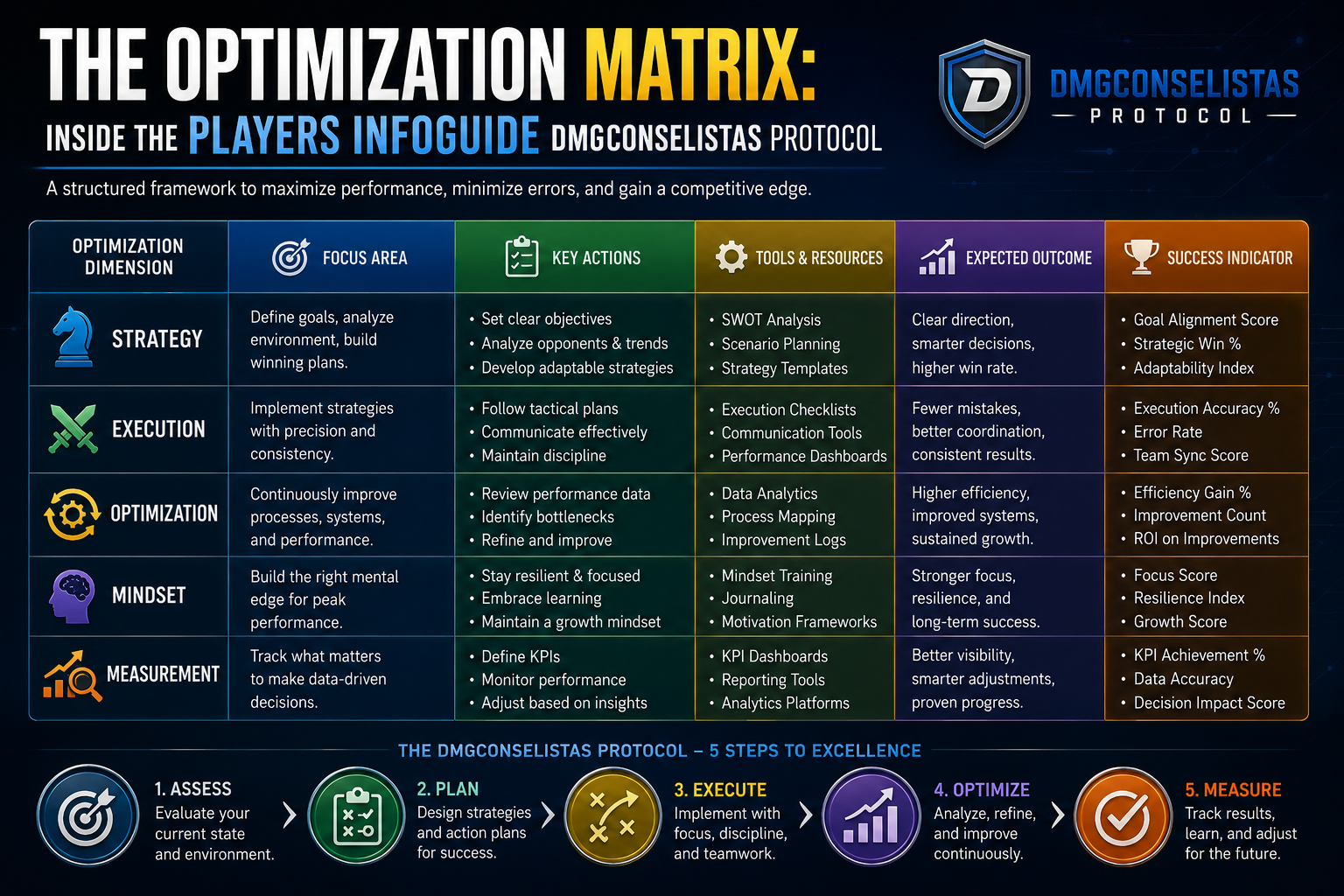
In the rapidly evolving world of competitive gaming and role-playing games (RPGs), mastering a game’s combat mechanics requires separating surface-level numbers from underlying logic. Players who want to move past basic strategies often use advanced structural guides. In gaming communities, these specific strategic blueprints are commonly categorized under the operational term “dmgconselistas“—a core methodology used within a Players Infoguide to calculate, consolidate, and maximize damage output while minimizing combat vulnerability.
The dmgconselistas approach (short-form taxonomy for damage optimization matrices and console listings) focuses on breaking down a game’s core mechanics into predictable variables. By converting complex code interactions into logical combat sequences, players can design optimized character setups that perform reliably in high-stakes encounters.
The Anatomy of the Dmgconselistas Matrix
A common mistake made by casual players is focusing entirely on increasing a character’s base attack power. While a high raw attack value looks impressive on a character screen, it represents only the initial layer of a multi-tiered calculation system. The advanced methodology divides a character’s total output into four distinct operational layers.
[Raw Attack Power / Base Base Modifier]
                  │
                  ▼
[Additive Stat Percentages & Weapon Buffs]
                  │
                  ▼
[Multiplicative Critical Elements & Modifiers]
                  │
                  ▼
[Enemy Damage Mitigation & Armor Reduction]
Layer 1: Base Modifiers and Scaling
The foundation of any combat build relies on base modifiers. This value represents the intrinsic power of a chosen class or weapon before any external buffs, armor sets, or passive skills are applied. This layer dictates how effectively a character scales as they level up. If a character possesses a weak base scaling coefficient, overloading them with high-end late-game gear will still yield sub-optimal results compared to a character with structurally superior base attributes.
Layer 2: Additive vs. Multiplicative Stacking
The core of the methodology relies on understanding the difference between additive and multiplicative stacking. This distinction is where many builds succeed or fail.
-
- Additive Modifiers: These stats add directly to a base value. For example, if two separate passive skills provide a 10% bonus to a base attack of 100, the calculation is straightforward: 100 + 10 + 10 = 120.
- Multiplicative Modifiers: These stats multiply the cumulative total, which accelerates damage growth. Using the same example with multiplicative factors changes the math significantly: 100 × 1.10 × 1.10 = 121.
As gear quality improves and additional stat layers are introduced, multiplicative modifiers become increasingly valuable. This makes them a priority for high-level endgame content.
Advanced Stat Budgeting and Diminishing Returns
When optimizing an overall setup, a player must manage limited resources, such as finite gear slots, skill points, and stat allocations. Achieving maximum efficiency requires balancing different attributes rather than hyper-focusing on a single stat.
Managing Diminishing Returns
In most game engines, continuously stacking a single attribute eventually triggers diminishing returns. This means each additional point invested yields a smaller percentage increase in actual performance. For instance, increasing a critical hit chance from 10% to 20% doubles the frequency of critical strikes, which noticeably changes combat effectiveness. However, moving that same stat from 80% to 90% provides a much smaller relative upgrade, despite requiring the same amount of stat investment.
The method solves this issue by identifying optimal thresholds, often referred to as “stat caps.” Once an attribute hits its designated soft cap, resources are redirected into complementary stats to boost overall performance.
          ┌──────────────────────────────────┐
          │     Target Threshold: 60%        │
          │      Critical Hit Chance         │
          └────────────────┬─────────────────┘
                           │
                 [ Threshold Met? ]
                           │
                 ├──► YES: Reallocate extra points to Critical Damage
                 └──► NO:  Continue investing in primary Critical Chance
Balancing Critical Chance with Critical Damage
A classic example of stat budgeting is maintaining the proper ratio between critical hit chance and critical hit damage. Having an exceptionally high critical damage multiplier is useless if a character rarely scores a critical hit. Conversely, a 100% critical rate underperforms if the critical damage bonus matches the base attack damage. Advanced player guides generally recommend a balanced 1:2 ratio (e.g., a 50% critical chance paired with a 100% critical damage bonus) to ensure steady, reliable output over extended encounters.
Environmental Factors and Target Mitigation
A calculation model is only useful if it accounts for enemy defenses. A build that performs flawlessly against training targets can struggle in real-world scenarios if it fails to account for target mitigation layers.
Piercing Armor and Resistance Layers
Monsters, bosses, and opposing players in competitive environments use various defensive mechanics to reduce incoming damage. These typically include physical armor values, elemental resistances, and flat damage absorption barriers. The optimization matrix evaluates how to counter these defenses using specialized stats:
-
- Flat Armor Penetration: Subtracts a fixed value directly from the target’s armor score, making it highly effective against lightly armored targets.
- Percentage Penetration: Reduces the target’s total armor by a set percentage, which makes it essential for cutting through heavily armored boss units.
- Elemental Shredding: Lowers a target’s elemental resistances, allowing magical or elemental builds to deal closer to their maximum potential damage.
Maximizing Combat Status Effects
Modern combat systems frequently incorporate status effects and crowd-control mechanics. Applying vulnerabilities, elemental blights, or physical debuffs to a target directly enhances a team’s total output. The guide highlights the importance of sequencing these abilities correctly: a debuff must be applied at the start of a combat rotation to ensure all subsequent high-damage abilities benefit from the amplified damage window.
Practical Optimization Roadmap
To simplify these complex mechanics into an actionable strategy, players can follow a structured implementation process.
| Phase | Core Objective | Tactical Action | Expected Combat Result |
|---|---|---|---|
| 01 | Establish Base | Identify and maximize core weapon attributes and scaling | Ensures a reliable foundation for all future stat upgrades |
| 02 | Balance Ratios | Allocate points to maintain a steady 1:2 critical ratio | Stabilizes damage output and prevents wild performance swings |
| 03 | Apply Piercing | Integrate armor penetration to counter target mitigation | Maintains high efficiency against heavily armored enemies |
| 04 | Optimize Rotation | Align abilities to maximize active debuff windows | Delivers peak burst potential during critical phases |
Executing the Strategy
The final phase of the methodology shifts from theoretical planning to in-game execution. True optimization requires testing theories in live combat scenarios to see how they perform under pressure.
By tracking actual performance data and comparing it against the structural blueprint, players can fine-tune their builds. This process eliminates guesswork, allowing players to adjust their setups based on clear metrics. This methodical approach elevates a player’s performance, turning complex underlying game code into a reliable tool for consistent victory.












Leave a Reply